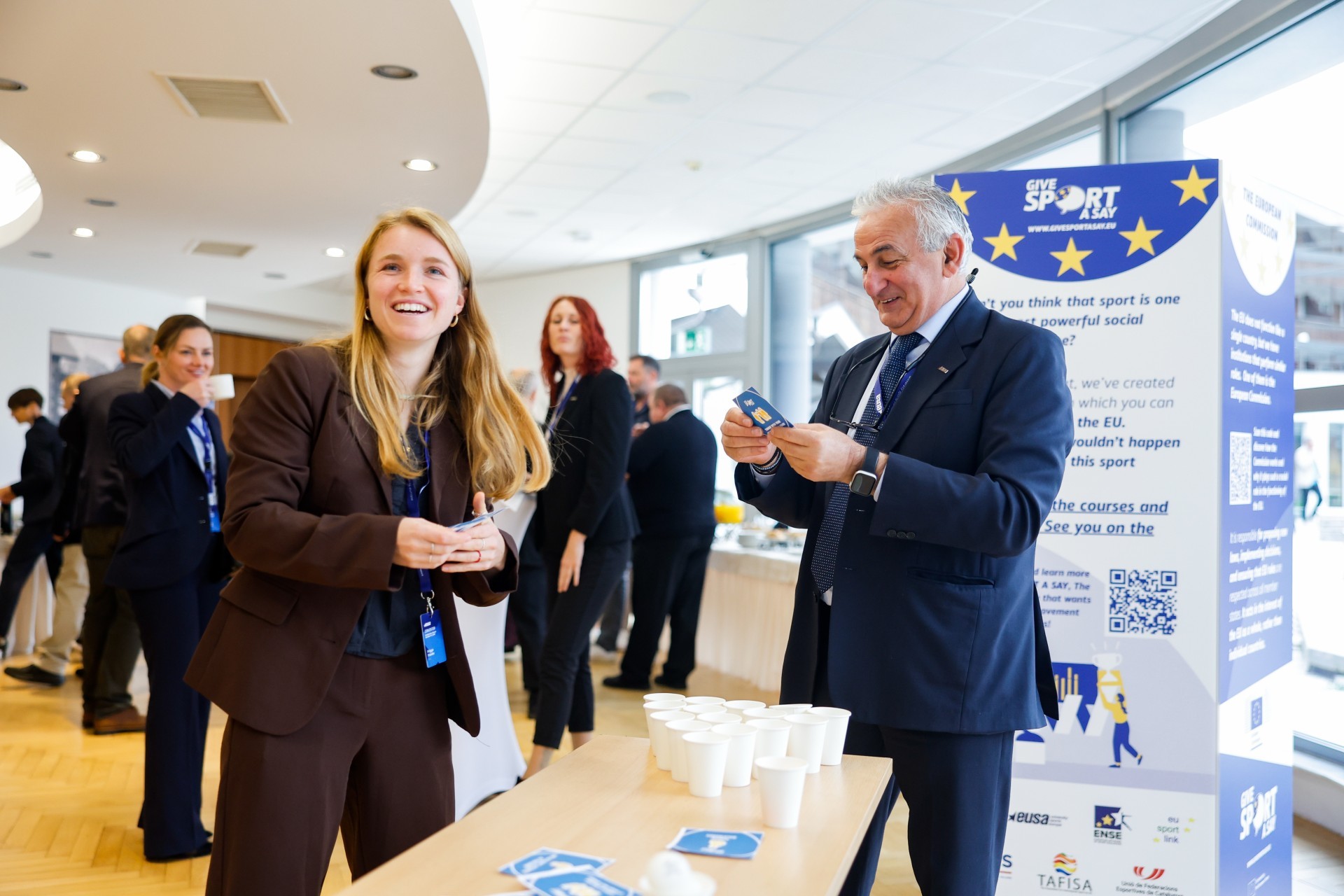
From 5 to 8 November, TAFISA Project Coordinator Frigga Franke was in Kranjska Gora, Slovenia, to attend the Convention 2026 of the European University Sports Association (EUSA) and support the Give Sport a Say activities taking place as part of the programme.
The Convention brought together EUSA's Technical Delegates, the Organising Committees of the European Universities Championships 2027 and invited guests. Over four days, participants exchanged experiences and coordinated their preparations for the 2027 Championships. The Convention was powered by the Give Sport a Say project, co-funded by the European Union.
Give Sport a Say is a European initiative that uses sport as a space for civic participation. Co-funded by the European Union under the CERV programme, the project engages citizens of all ages, backgrounds and abilities in real sport environments. It collects ideas, concerns and proposals directly from people active in the sport movement, so that their voices help shape the future of sport in Europe.
All input gathered at the events will be compiled into a European Policy Recommendation Report, to be shared with EU institutions, sport organisations and policymakers.
Quizzes, games and a question of fairness
On the second day of the Convention, Andrej Pisl, EUSA Director of Projects and Policy, and EUSA Education Officer Milia Molinie presented the Give Sport a Say project to participants. In an interactive quiz, participants then tested their knowledge of the European Union, its institutions and the role sport organisations play in policy-making.
Frigga Franke supported the interactive games, mainly the Fairpong Game. Fairpong is an adapted version of ping pong with a twist: before playing, each player secretly draws an instruction card that makes the game easier or harder, such as "only 3 attempts", "use your non-dominant hand" or "4 balls instead of 3".
After the round, the cards are revealed and players are asked one simple question: Did it feel fair? A short discussion follows, based on an article of the EU Charter of Fundamental Rights printed on the back of each card, covering topics such as equality, non-discrimination, gender equality and inclusion.
The game created a playful atmosphere and sparked lively conversations among Technical Delegates, Organising Committee members and EUSA staff. In just a few minutes of play, abstract rights became something participants could feel for themselves.
A warm thank you to EUSA for being such excellent hosts. Read more about Give Sport a Say here.